
 Available in US
Why British Hockey Bettors Need a Different Brief
Seven years of pricing British hockey slates have taught me one thing above all: the punter who treats the NHL and the EIHL as a single sport leaves money on the table every weekend. NHL puck-drop times run from 23:00 to 06:00 GMT, with deep North-American-style markets and fractional UK pricing layered on top. The EIHL plays in front of British crowds, in British arenas, but with thinner liquidity, slower-moving lines, and an entirely different data landscape. The two sit on the same bet slip and behave like distant cousins.

This is a UK-focused analytical brief for hockey punters. Not a marketing landing page for any operator and not a US Stanley Cup primer with the dollar signs swapped for pounds. Every figure here is filtered through UKGC reality — fractional odds, GamStop access, financial-risk-check thresholds. Three fronts matter: the NHL (volume and the overnight slot), the EIHL (the home league with record-breaking 2024-25 numbers), and the IIHF World Championship in May (the short, sharp tournament that catches every casual punter off guard).
A British hockey punter is really working two markets at once: a saturated, fast-moving NHL board priced from North-American sharps, and a thin, news-driven EIHL board where one alert line-shopper can move the price.
Puck line — the hockey equivalent of a handicap, fixed at ±1.5 goals. The favourite has to win by 2 or more; the underdog covers by winning straight up or losing by exactly 1. Overtime and shootout settle the bet, and empty-net goals decide more puck-line covers than most punters expect.
The deeper lesson is one Adrian Horton, director of North American sports trading at ESPN BET, framed about the postseason — "smaller margins between even the best and worst teams." That compression is the whole edge to chase. Find the matchups where the implied probability lags the underlying performance, place the bet at the right price, walk away when the line catches up. What follows: the UK market frame, the leagues you will trade, the markets you will use, the league-specific reads, and the bankroll rules that keep you in the game past month three.
Quick Read: Sharper Edges for UK Hockey Punters
- An edge in UK hockey betting means catching mispriced home favourites and empty-net puck-line traps before North-American sharps move the line.
- NHL home favourites covered -1.5 only 41.8% of the time in 2024-25, while +1.5 underdogs covered around 60%. The puck line punishes lazy chalk-backing.
- The EIHL belongs in any UK portfolio — 1,321,128 fans in 2025-26, thinner books, slower lines, real value on home dogs at the right number.
- Stake one unit per bet, audit your closing-line value weekly, and use UKGC tools — deposit limits, GamStop, time-outs — as part of the system, not an emergency brake.
- This guide reads NHL, EIHL and IIHF together, which US-style Stanley Cup primers cannot do for a British punter.
Inside the £16.8 Billion UK Betting Frame
The first time I sat in a room with a UKGC compliance officer, I left understanding why every other line in a British bookmaker's product brief sounds like a legal disclaimer. The regulator runs a market that produced £16.8 billion in gross gambling yield over the year to March 2025, growing 7.3% — and every operator chasing that revenue is one weak audit away from a Section 116 review. That dynamic shapes everything a hockey punter sees on screen.
£16.8bn
Total UK GGY 2024-25
£7.8bn
Online GGY
£2.6bn
Online sports betting
2.7%
UK problem-gambling rate

Inside that £16.8 billion, online does £7.8 billion (a 13.1% year-on-year rise), and online sports betting itself accounts for £2.6 billion. Hockey lives inside that £2.6 billion, sharing real estate with football, racing, tennis, cricket, golf and a long tail of niche sports. Andrew Rhodes, the UKGC's chief executive, framed the macro picture cleanly in a recent address: "Recent data published shows that total gross gambling yield (GGY) is at its highest ever level at £15.6bn. Participation in gambling has remained stable at 48%, just under half of the adult population in Great Britain." Stable participation, growing yield — the average British gambler is spending more, not multiplying.
Football alone takes £1.3 billion out of that £2.6 billion online-sports pot. Hockey shares the remaining half with racing, tennis, cricket, golf and a thin tail of other markets. That scarcity matters: it is exactly why hockey lines move slower, react to news with a lag, and reward the punter who reads the data feed at 02:00 GMT rather than at 09:00 GMT.
The BGC side of the ledger is the one most British punters never look at. Betting and Gaming Council members contribute £6.8 billion to the UK economy each year, deliver £4 billion in tax receipts, and support 109,000 jobs. That economic footprint is what keeps the regulatory conversation balanced between protecting punters and protecting an industry. If you wonder why the financial-risk-check rollout took months of consultation rather than a single Whitehall announcement, the answer is buried in those nine zeros.
Now the harder number. 2.7% of adults in Great Britain — about 1.4 million people — score 8 or higher on the PGSI screen, the benchmark for problem-gambling indicators. That is the figure that drives statutory levy debates, deposit-limit defaults, advertising rules and the way an operator handles a punter whose stake patterns spike. If you bet on hockey, you operate inside a regulatory system designed around that 2.7%, and pretending otherwise is the surest way to get caught off-side by a sudden affordability check.
Why UKGC numbers matter for a hockey punter
The reason a British sportsbook will throttle your stake before a US-only book ever notices you exist is buried in those macro figures. UKGC operators face strict-liability rules around money laundering, problem-gambling identification and advertising tone. That is why your bonus is smaller than a US punter's, your withdrawals are sometimes delayed for verification, and your high-stakes accumulator on the EIHL might get a manual review. The system is regulating the market, not punishing you. Knowing how it works lets you avoid friction and focus on the bets that actually move your bankroll.
What this means for the rest of the article: every market behaviour we discuss — NHL puck-line mispricing, EIHL line lag, IIHF Worlds outright pricing — happens inside this regulated frame. The frame is not a footnote. It is the table itself, and the punter who works with it instead of against it gets to keep playing across multiple seasons rather than burning out in the first three months of trial and error.
Five Hockey Leagues a UK Punter Should Map
Walk into any UK sports betting forum on a Tuesday night in February and you will see three threads stacked side by side: one on a Toronto-Tampa overnight slate, one on Sheffield travelling to Belfast, and one on a SHL game nobody has properly modelled. The British hockey punter does not bet "hockey" — they bet five separate leagues, each with its own market depth, news flow and price behaviour. Mapping those five leagues is the first job before you ever touch a stake.
The NHL sits at the centre of every UK book's hockey product. Eighty-two regular-season games per team, October to April, then a 16-team playoff bracket running into June. Florida Panthers won back-to-back Stanley Cups in 2024 and 2025, beating Edmonton Oilers in a six-game final last summer, and the market has rebuilt around their core entering 2025-26. Premier Sports holds exclusive UK broadcast rights for both the NHL and the EIHL through the end of the 2025-26 season, so the same subscription that gets you Florida-Edmonton overnight also gets you Sheffield-Nottingham on a Saturday teatime.
NHL
32 teams, 82 regular games, 16-team playoff bracket. UK puck-drop 23:00-06:00 GMT. Deep market: moneyline, puck line, totals, period bets, dozens of player props per game. Lines move on US-based information flow within minutes of a starter announcement.
EIHL
10 teams, ~270 matches in 2025-26, single-game and Challenge Cup structure. UK puck-drop 19:00-19:30 GMT. Thin market: moneyline and totals widely offered, props and futures patchy. Lines move slowly because there are far fewer sharp eyes on the price.

The EIHL is the league where a British punter has the largest informational edge — if they choose to put the work in. The 2024-25 season set a 22-year attendance record at 1,247,972 fans across the schedule and an average of 3,660 per match. The current 2025-26 season has already cleared that, with 1,321,128 spectators and an average of 3,863 across the 270 fixtures. Tony Smith, the league's chairman, has been blunt about what those crowds mean off the ice: directly and indirectly, the EIHL puts "between £8-10m into the economy every year." That economic footprint is small enough that books treat the league as a niche product and price it accordingly.
The IIHF tournaments are the third pillar. The World Championship runs each May, the World Junior Championship over Christmas and New Year, and the Olympics every four years. The 2025 Worlds in Sweden and Denmark drew 489,450 spectators across 64 matches, with a goals-per-game average of 5.83 and the United States taking a third title. For UK punters, this is a compressed two-week price window where outright betting becomes interesting because the field is small, public bias is concentrated on three or four nations, and the underlying form often diverges from the price. The IIHF World Championship outright betting guide covers the bracket maths in detail.
NHL
32 teams, 82 games, Oct-Jun, deep markets, overnight UK slot, US-priced.
EIHL
10 teams, 270 fixtures 2025-26, Sep-Apr, thin markets, evening UK slot.
IIHF Worlds
16 nations, 64 matches in May, outright and group markets, average 5.83 goals/game in 2025.
KHL
23 teams, Russia and neighbours, Sep-Apr, limited UK book coverage, sanctions-affected.
SHL / CHL
Swedish league plus Champions Hockey League, Sep-May, niche UK pricing, sharp Nordic markets.
Stanley Cup — the NHL's championship trophy, awarded since 1893 and contested each June in a best-of-seven final between the Eastern and Western Conference champions. Futures and outright betting on the Cup opens the day the previous final ends.
Challenge Cup — the EIHL's mid-season knockout competition, run alongside the regular league season. Group stage in autumn, two-legged knockouts in winter, single-game final in February or March. Nottingham Panthers picked up their ninth Challenge Cup last season.
The KHL and the Nordic markets round out the five. KHL coverage on UK books is patchy at best — sanctions, scheduling and integrity concerns mean most UKGC-licensed operators offer a thin moneyline-and-totals product and nothing deeper. SHL and the Champions Hockey League sit in the same niche bucket, with sharp Scandinavian models setting the price and very little public liquidity in the UK pool. Neither league belongs in a beginner's portfolio, but both reward a punter with a specific regional read who is happy to wait for a soft number.
The Core Hockey Markets, Decoded
The first market I ever priced on hockey was a moneyline, and the first mistake I ever made was treating it like a football match-winner. Hockey settles on regulation, overtime and shootout, with overtime running three-on-three for five minutes, then a three-shooter shootout if the score remains level. That single rule changes the maths on every market on the board, and a British punter who is fresh from football match betting will misprice the puck line and the totals in their first session.
The moneyline is the bare match winner: pick the team that lifts the points at the end of any tiebreaker. NHL home favourites won straight up 64.1% of the time in 2024-25, a 555-231-54-26 record that looks like a printing press until you remember the price you have to pay to back them. Home underdogs covered against the spread in 63.9% of matches in the same window — and that gap is where most chalk-leaning UK punters lose their edge over a 200-bet sample.
Worked example: how a UK book displays the same price three ways
| Format | Notation | £10 stake returns |
|---|---|---|
| Fractional (UK default) | 11/10 | £21.00 |
| Decimal | 2.10 | £21.00 |
| American | +110 | £21.00 |
A £10 stake at 11/10 returns £21.00 (£10 stake plus £11.00 profit). Implied probability: 47.62%. Every UK book lets you switch between formats in account settings — switch to decimal for value calculations, then back to fractional for the slip if you prefer.
The puck line is the fixed handicap that defines hockey betting. The favourite has to win by 2 or more goals; the underdog covers by winning straight up or losing by exactly 1. That ±1.5 number is fixed because the underlying goal totals in hockey cluster so tightly — a hockey game typically lands within one goal either way of the median. The 2024-25 NHL season is the puck-line punter's textbook: home favourites covered the -1.5 only 41.8% of the time, while +1.5 underdogs hit around 60%. For the strategy detail across a full season, the how puck-line value behaves across the season piece runs the month-by-month splits.
Empty-net adjustment — the late-game distortion when the trailing team pulls its goaltender for an extra skater, swinging the puck line on roughly one in five NHL games. A -1.5 favourite who is 4-3 with two minutes left becomes a 5-3 cover on an empty-netter. The market prices that swing into every puck-line number you see.
Alternate spread — a non-standard handicap (±2.5, ±3.5, or even ±0.5 with no overtime) priced separately from the main -1.5 line. UK books offer alternates on most NHL games and on top EIHL fixtures. The price reflects the same underlying model, just shifted along the goal distribution.
Totals (over/under) live on a tighter band than most punters expect. The 2024-25 NHL season averaged 6.1 goals per match, and Unders hit on the 6.5 total in 57% of games — a real, repeatable lean in a single direction, up from 53% the prior season. The shift is not random. Goaltender save percentages dropped to a 30-year low across the same season, which sounds like it should mean more goals, but in practice it pushed books to set higher totals that the under-the-radar Under has kept clearing. Be careful of overreacting to that single-season pattern, but the lean is in the data.
Player props are the deepest part of the modern hockey market. Goals, assists, points, shots on goal, blocked shots, hits, time on ice — every NHL book offers a dozen or more lines per skater, plus a goaltender saves market with its own pricing model. Connor McDavid finished 2025-26 with 138 points (90 assists, 48 goals), and Nathan MacKinnon hit 53 goals across the same window; both numbers were priced inside futures and prop markets that opened in September. EIHL props are thinner, but the soft pricing in those small markets is exactly why a punter who watches the league regularly can find an edge.
Futures and outright markets are the long-form bets: Stanley Cup winner, Conference winner, Hart Trophy, Rocket Richard. Period betting is the short form: moneyline or totals on just the first, second or third period, with no overtime risk. Both serve a portfolio purpose. Futures lock in price early — if you backed Florida at 12/1 in October 2023, you collected after both 2024 and 2025 finals. Period bets let you express a strong start-of-game read without taking on 60 minutes of variance.
The NHL ranks ninth out of 12 hockey leagues worldwide by favourite win rate at 61.93%, with the SHL bringing up the rear at 59.04%. The top three leagues by favourite win rate are all Ligue Magnus clubs in France. The NHL is one of the most competitive leagues in world hockey, which is exactly why chalk-backing strategies get punished over a full season.
NHL Through a British Punter's Lens
My alarm goes off at 02:45 GMT three nights a week from October to April. That is not the start of a wellness regime — that is the only window when a UK punter can watch the third period of a West Coast NHL game and act on what the eye sees before the line settles for the next slate. The NHL is a UK punter's overnight market, and the four factors that drive its pricing all show up in that overnight slot.
Back-to-backs are the single most exploitable schedule signal in the league. Teams playing the second night of a back-to-back have gone 205-309 straight up since the 2023 season — a 40% win rate against books that usually price them within 10-15 cents of the same team rested. The fatigue compounds: the lower-quality goaltender often starts, the top line gets shortened minutes, and the team that opens with shape and structure tends to win the period markets early.
Goaltender form is the second factor, and 2024-25 made it the headline story. NHL save percentages dropped to their lowest level in three decades across the regular season. Martin Biron, the former NHL goaltender and now a broadcaster, framed the cause directly: "All of that auditing that the league is doing with shots, and honestly it stems from gambling. People don't want to lose their bets if there was a shot that was missing the net or whatnot." The league tightened the definition of what counts as a shot on goal under betting-market pressure, and the SV% denominator moved against every goaltender at once. A UK punter who reads SV% as a like-for-like comparison across seasons is reading a number that has been redefined under their feet.
Star-skater scoring is the third factor. Connor McDavid finished 2025-26 with 138 points on 48 goals and 90 assists — a season that anchored every Hart Trophy futures market for nine months and pulled Oilers totals up by half a goal on most slates he played. Nathan MacKinnon hit 53 goals across the same window. When a star skater is on a heater, books move the team total before they move the moneyline, and the punter who is watching the prop board first catches the move first.
The UK midnight rule: if puck-drop is after 02:00 GMT and you are not planning to watch live, set your bets before 22:00 GMT and stop. Late lines move on starter announcements, scratches and weather at the arena, and the British punter chasing the price at 23:30 is almost always taking the worst of it.
Time zones are the fourth factor and the easiest to underestimate. The early NHL slate (US East games starting 19:00 local) drops at midnight UK, and that is the only window a working punter can comfortably watch. Late West Coast games starting 22:30 PT drop at 06:30 GMT — for a UK punter, this is a closed-line market. The right move is to commit to overnight East and Central matchups, skip the late West unless you genuinely intend to follow them, and stop fighting the time zone with NyQuil and willpower. For the practical NHL play across a full week — schedule reading, line shopping, model inputs — the NHL betting strategy from the UK angle covers the deep work.
The NHL's depth and overnight slot make it one of two main fronts for a British punter. The other front sits 4,500 miles closer and plays in a market that moves on entirely different signals — the Elite League.
The Elite League Plays Like a Different Sport on the Market
Sheffield Steelers averaged 7,978 fans per match in 2024-25, more than several League Two football clubs managed across their entire home season. Cardiff Devils win more than 70% of their matches at the Vindico Arena. Those two numbers — attendance density and home dominance — tell you almost everything about why the Elite League trades like a different sport than the NHL on a UK book.

The home factor is louder in the EIHL than in any other league a UK punter will see. The arenas are smaller, the crowd sits closer to the ice, and the travel for visiting teams is genuine — Belfast to Cardiff is a full day on planes and coaches. Cardiff Devils sit on a 70%+ home win rate at the Vindico Arena across recent seasons, a figure no NHL team consistently sustains. Belfast Giants closed last season with their eighth regular-season title, Cardiff added a fourth Playoff Championship, and Nottingham Panthers picked up a ninth Challenge Cup. Three trophies, three different clubs, each result anchored in home form during the run-in.
Why the EIHL plays like a different sport on the market: NHL lines move within minutes of a starter announcement because dozens of sharp models are running on every game. EIHL lines can sit at the opening number for a full day because nobody is modelling the league at scale. That is the punter's whole opportunity — line shopping across three or four books, the morning of the match, before the public flow settles the price by 18:00.
Top scorers in the league finish their seasons in the 35-50 goal range with shot-on-goal averages of 3.5 to 4.5 per game. Those are the names that price up the first-goalscorer and anytime-scorer markets, and they are also the names where a UK punter watching one team closely can spot a hot streak the book has not yet priced in. The thinness of the EIHL prop market is the punter's friend: there are not enough sharp eyes on the league to keep every line tight, and a value line that opens at 5/1 on a first goalscorer can stay there until 30 minutes before face-off.
The flip side of thin liquidity is volatile pricing on news. An EIHL line can move sharply on a goaltender scratch announced an hour before puck-drop, because the book is reacting to information the same way the punter is. The best entry point is usually 12 to 24 hours out, when the opening number is on the board but the public flow has not yet arrived.
Sheffield Steelers hosted Nottingham Panthers on Boxing Day 2024 in front of 9,638 fans — a single-match crowd larger than the average regular-season attendance for nearly any League Two football club. That fixture is one of the most reliably value-rich matches on the EIHL calendar, because the books cannot ignore the public emotion but the underlying form table often disagrees with the price.
For a punter who wants to build a season-long EIHL portfolio — schedule reading, scout-network tips, line-shopping tactics — the full EIHL betting guide for the 2025-26 season walks through the league fixture by fixture. The pillar piece you are reading is the strategic overview; the cluster piece is the operating manual.
In-Play Hockey: Six in Ten Bets Now Land Here
Face-off plus seven minutes. A West Coast game, two early shots on net, the road team has structure but the home crowd is settled. The pre-match line had the home team at 1.85 on the moneyline; the in-play book now offers 2.20. Half my betting bankroll across the season runs through windows like that one — and across the global online betting industry, 62.35% of all bets are now placed after the action starts.
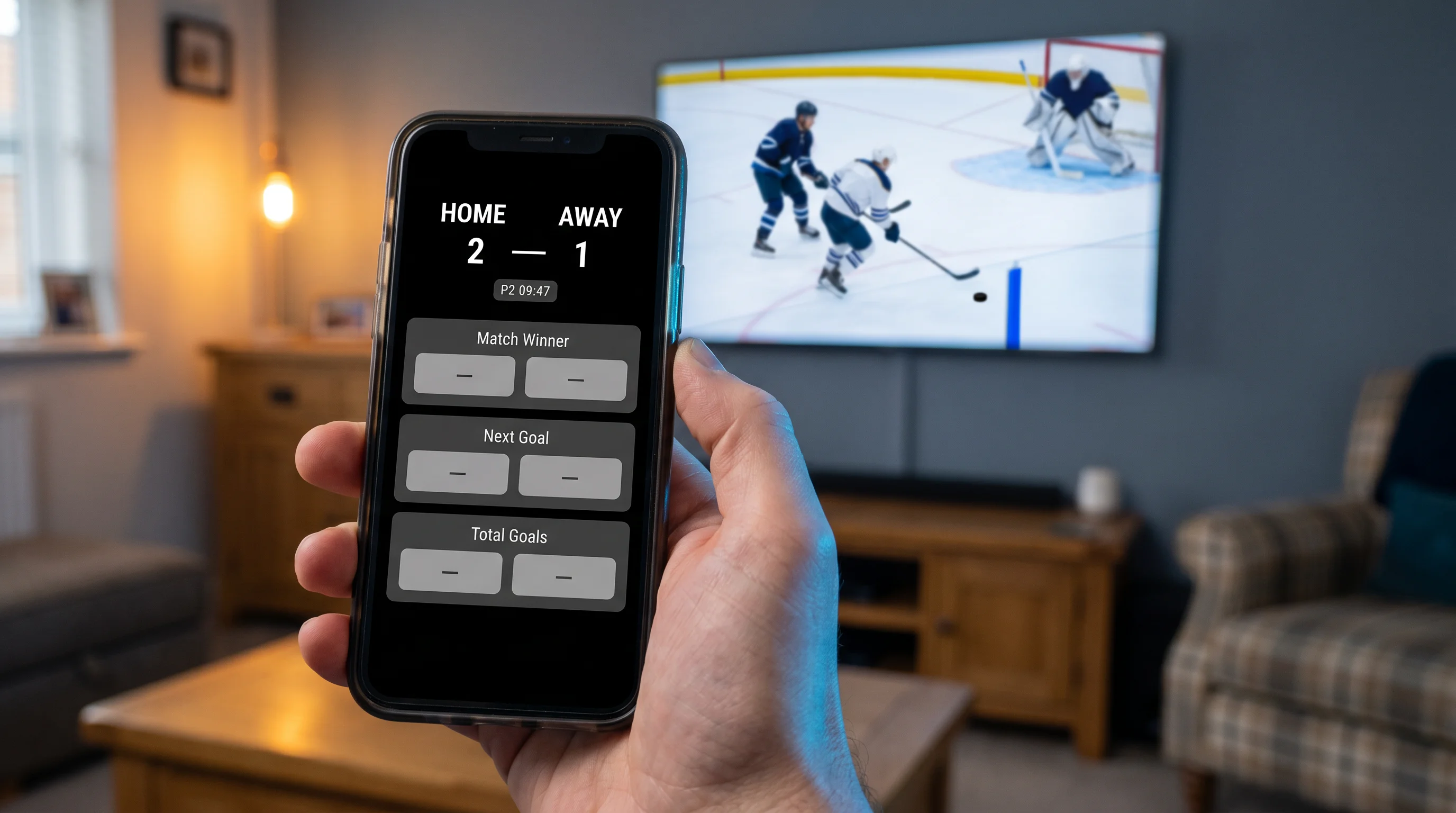
Six in ten online bets are now placed after puck-drop, kick-off or first pitch. In-play has overtaken pre-match across every major sport, and hockey is no exception. The faster the pace of a sport, the larger the in-play share — and hockey averages a stoppage every 80 seconds, which is exactly why the live book moves faster than a human reader can keep up with.
The signals that matter in-play on a hockey match are different from the ones that matter pre-match. Pre-match, you are pricing models, schedules, goaltender history and travel. In-play, you are reading tempo: which team is winning the neutral zone, which power play has structure, which goaltender is fighting the puck. The book reacts to scoreline and shots on goal, but those numbers lag what the eye sees on the ice by 30 to 60 seconds.
Three in-play scenarios where UK lines lag
One, an early road goal in the opening five minutes. Books over-correct the moneyline because the goal is recent and dramatic, but the underlying expected-goals balance has barely shifted. Two, a late first-period penalty that does not lead to a goal. The price of the trailing team often drifts because nothing has happened on the scoreboard, even though the power play built momentum. Three, a goaltender pull with three or more minutes left in the third. The trailing team's puck-line price moves slower than the empty-net risk justifies — and the alternate spread can be the cleanest expression of that gap.
The newest layer in this market is the prediction-market overlay. The NHL has formally partnered with Kalshi and Polymarket, becoming the first major North American sports league to sign that kind of agreement. For UK punters, the operational impact is indirect — prediction markets are not licensed for UK consumer use — but the informational impact is direct. Prediction-market prices on game outcomes, championship odds and player props now sit in the same data ecosystem as the traditional sportsbook lines, and the two often disagree by enough to flag a mispricing on the regulated UK book.
In-play hockey rewards the punter who watches at least the first period live and decides whether to bet after the action has spoken. The patterns that repeat — first-goal overreactions, penalty-kill momentum shifts, third-period pull mispricings — show up week after week. The in-play patterns British punters should learn piece runs them with worked examples and the live-screen workflow for West Coast slates.
The Research Stack I Run Before Every Slate
Open six tabs. NHL.com for the box score and the official starter announcement. Hockey-Reference for career-length splits on every skater on the slip. Natural Stat Trick for expected-goals share, Corsi For percentage and shot-quality breakdowns the book does not show you. EIHL Pressroom for the league announcements and injury notes. IIHF.com for tournament fixtures and historical bracket form. Daily Faceoff for confirmed line-ups inside the 90-minute window before puck-drop. Those six tabs are the entire stack, and every one of them is free.

The metrics that matter are smaller in number than most punters think. SV% over the most recent 10 starts, not the season average — recent form on a goaltender is more predictive than the underlying career number once the sample has 8-10 games in it. High-danger SV% from Natural Stat Trick filters out the cheap save against a long shot from the rim. Power play percentage (PP%) and penalty kill percentage (PK%) for both teams across the last 10 games. Corsi For percentage at five-on-five as a tempo proxy. That is the whole metric stack. Anything beyond it is detail.
The league-context number is the one most casual punters miss. The NHL ranks ninth out of 12 hockey leagues globally on favourite win rate at 61.93%, while the top three favourite-win-rate leagues are all Ligue Magnus clubs in France. That tells you backing chalk in the NHL is statistically harder than backing chalk in any of eight other leagues a UK book may price.
Pre-bet checklist: six items, every match, no exceptions
- Confirm the starting goaltender from Daily Faceoff inside the 90-minute window before puck-drop. A backup start can swing the moneyline by 15-20 cents.
- Check both teams for back-to-back status. The second night of a back-to-back is a 40% straight-up market across the past three seasons.
- Pull PP% and PK% over the most recent 10 games for both teams. Average the special-teams differential and feed it into your total.
- Pull the home form table for the season. EIHL home factor swings stronger than NHL; both move on home/away splits that lag the closing line.
- Line-shop the same market across at least three UKGC-licensed books. A two-cent difference on a level-stakes bet compounds across a season.
- Decide your stake before the price opens, not after. Setting unit size at the market open prevents tilt-staking on a line that has already moved against you.
✓ Do
- Verify the confirmed starter inside the 2-hour pre-game window.
- Track closing-line value weekly and review which markets you are beating.
- Stake one flat unit until you have 200 bets of evidence on your model.
- Walk away after a -3 unit session, no exceptions, no exit hand.
✗ Don't
- Chase first-goalscorer odds in the last 15 seconds before puck-drop.
- Add a hockey leg to a multi-sport accumulator to "settle" the slip.
- Bet props on a goaltender whose last 5 starts you have not actually watched.
- Re-stake after a bad beat in the same session you took the beat.
One word of warning on shot-based props. Jake Oettinger, the Dallas Stars goaltender, has been direct about how the shot-counting clean-up has hit the underlying metric: "They just take shots away that are shots on goal. There are probably three a game. If you multiple that by 50 games, that's like having five more shutouts that they're taking away." If you are betting an over on a goaltender's saves prop or an over on team shots, you are betting into a metric that has been redefined inside the last 18 months. Read every line with that adjustment in mind.
Bankroll Discipline and the UKGC Safety Net
My bankroll rule is the one rule I have never broken across seven seasons, and it is the simplest rule in the whole stack. One unit equals 1% of the working bankroll, every bet at one unit, flat staking, no exceptions, and a hard stop at -3 units in any single session. That is the entire framework. Everything else — Kelly fractions, progression staking, recovery systems — is either a refinement on the simple version or a way to lose your bankroll faster than the simple version would have.

The reason flat staking matters is variance. A 200-bet sample on hockey will swing 20 to 30 units up or down even with a positive expected-value model, and a punter who is varying stake size with confidence is amplifying the swing in both directions. The Kelly fraction is a refinement for the punter who has 1,000 settled bets with a measurable edge and a reliable closing-line-value record. For the punter who does not yet have that history, flat staking is the floor.
Around 15-17% of British men report betting on sport in a given year. Around 4% of British women do the same. Sports betting is a male-skewed activity, and the regulatory tools are designed around that demographic skew. The UKGC operator has to identify problem-gambling indicators inside that population and act on them. Those tools are not bureaucracy; they are the system that keeps the market legal for everyone else.
UKGC tools every hockey punter should know
Deposit limits set a daily, weekly or monthly cap on what hits your account, and you set them on the account-settings page in five minutes. Time-outs lock the account for 24 hours, a week or up to six weeks, and the operator cannot reverse the lock once it is set. Self-exclusion via GamStop covers every UKGC-licensed operator in a single registration. Financial risk checks are the formal affordability layer, with light-touch passive checks at lower thresholds and active checks at higher ones. None of these tools require a problem to use — most of mine were set in profile in the first week of the season as a discipline measure, not a recovery measure.
GamStop — the UK's national multi-operator self-exclusion scheme, free for any UK-resident punter to use. A single registration through the GamStop website covers every operator licensed by the UK Gambling Commission for the period selected (six months, one year, or five years), and the lock cannot be reversed until the period ends.
Statutory levy — the mandatory contribution from UKGC-licensed operators introduced in 2025, replacing the prior voluntary RET (Research, Education, Treatment) levy. The levy funds research into gambling harms, prevention and treatment services, and is collected at a rate set by HM Treasury.
The 2.7% number from the regulator is the one I keep on the home screen. About 2.7% of adults in Great Britain — roughly 1.4 million people — score 8 or higher on the PGSI screen for problem gambling. That is the population the UKGC system is built around, and a punter who knows where the boundary sits can keep betting through a bad month without crossing it. If your hockey stakes start to feel like compensation for the last loss rather than positions you would have taken cold, the tools above exist for exactly that moment.
Why we won't list non-GamStop sites: Andrew Rhodes, the UKGC's chief executive, has put it in one line — "There is nothing more exploitative than the illegal market." The Commission referred around 200,000 unlicensed URLs to enforcement partners last year, with roughly 100,000 successfully removed. A site that lets you bet outside GamStop is, by definition, outside the UK consumer-protection framework. We will not list one.
Frequently Asked Questions
What is puck line in ice hockey betting and how does it work?
The puck line is the hockey handicap, fixed at ±1.5 goals on the main market. To cover the -1.5 you back the favourite to win by 2 or more goals; to cover the +1.5 you back the underdog to win outright or lose by exactly 1 goal. The puck line is locked at 1.5 because hockey goal totals cluster tightly around the median. Overtime and shootout settle the bet — an OT winner counts as a 1-goal margin, which means a favourite who needs the -1.5 misses every overtime win on the main line. Empty-net goals are the other complication: roughly one in five NHL games has a meaningful empty-netter that decides the puck-line outcome.
How is NHL betting different from EIHL betting for a UK punter?
The two leagues sit on the same bet slip and behave like distant cousins. The NHL is priced by sharp North-American models within minutes of a starter announcement; lines are tight, prop markets are deep, and the closing line is genuinely efficient. The EIHL is the opposite — opening numbers can sit for hours, prop coverage is patchy, and the line moves only when public money arrives, often in the final two hours before puck-drop. The NHL rewards speed and access to live data; the EIHL rewards patience and a genuine eye on the league. The time zones also differ: NHL puck-drop runs 23:00 to 06:00 GMT, EIHL puck-drop runs 19:00 to 19:30 GMT — which is exactly why a British portfolio can comfortably hold both.
Which markets do UK bookmakers usually offer on ice hockey?
For the NHL: moneyline, puck line with alternate spreads, totals (5.5 through 7), period bets, both teams to score, props on goals, assists, points, shots on goal, saves, hits and blocks, plus futures on the Stanley Cup, conference winner and individual trophies. Most UKGC-licensed books also offer bet-builders on NHL games. For the EIHL: moneyline and totals are universal, the puck line is offered with reduced market depth, first goalscorer and anytime goalscorer are standard, and outrights on the regular season, Playoff Championship and Challenge Cup run through the year. IIHF World Championship coverage is strong in May, with group-stage and outright markets across major UK books.
How big is home-ice advantage in the NHL and should you bet around it?
Home favourites in the NHL won straight up 64.1% of the time in 2024-25 — a 555-231-54-26 record across the regular season. That sounds like a winning ticket, but the price you pay for backing home chalk on the moneyline eats most of the edge. The puck-line picture is the lesson: home favourites covered the -1.5 only 41.8% of the time, while underdogs covered the +1.5 in around 60% of matches. Backing underdogs at +1.5 on the puck line is historically more profitable than backing chalk at -1.5, despite the lower public preference. The asterisk is fair warning: this is a single-season snapshot, and the trend needs at least three seasons of data before you treat it as a stable rule.
What is the average over/under total in the NHL and what's the recent trend?
The 2024-25 NHL season averaged 6.1 goals per match, and Unders hit on the 6.5 total in 57% of games — up from 53% the previous season. The trend is unusually clean for a single-season pattern. Goaltender save percentages dropped to a 30-year low across the same window, which would normally push totals higher, but the books reacted by setting higher numbers, and the Under has cleared on the higher line more often than not. The underlying signal is a redefinition of what counts as a shot on goal under betting-market scrutiny. Treat the Under-on-6.5 pattern as a real lean while it persists, but be ready for the books to adjust their opening numbers in 2026-27.
How should I research goaltender matchups before placing a bet?
The stack is short. Pull SV% across the most recent 10 starts from NHL.com or Hockey-Reference. Pull high-danger SV% from Natural Stat Trick to filter out cheap saves on long shots. Check rest — back-to-back status, days since last start, total starts in the past 14 days. Pull the opponent's expected-goals-for per 60 minutes at five-on-five to estimate the shot quality the goaltender will face. Then confirm the starter from Daily Faceoff inside the 90-minute pre-game window. One caution on shot-based metrics: the league has tightened its shot-on-goal definition under betting-market pressure, and Jake Oettinger of the Dallas Stars has been clear that the audit takes "probably three a game" off the underlying number. Read every SV% and saves prop with that adjustment in mind.
How does the UK Gambling Commission regulate ice hockey betting?
Every operator that takes a bet from a UK-resident punter holds a UKGC remote operating licence and is subject to the licence conditions and codes of practice. That framework covers anti-money-laundering, self-exclusion through GamStop, problem-gambling identification, advertising tone, and the financial risk checks introduced in the latest white paper. The Commission also runs a sports-integrity function that monitors unusual betting patterns. On the integrity side, Gary Bettman, the NHL's commissioner, has noted that the league is structurally hard to fix: "I don't believe our game is susceptible in the way that some others might be... you can't really get away with that kind of cheating anymore." Hockey markets are monitored on the same basis as football and tennis, with around 200,000 unlicensed-operator URLs referred to enforcement last year and around 100,000 successfully removed.
Where to Read Next
Seven seasons of UK hockey betting have taught me that the punters who survive are the ones who treat the slate as a research problem first and a betting problem second. The NHL board is sharp and overnight; the EIHL board is thin and local; the IIHF Worlds is a compressed May window where outright pricing diverges most from underlying form. None of those three fronts rewards a punter who skips the data and trusts the gut. All of them reward the punter who reads the line, audits the closing-line value, and respects the bankroll rule on the morning after a bad beat. The work itself is the edge, and the edge compounds across a season for anyone willing to keep showing up at 02:45 GMT with a checklist in front of them and a clear stake decided before the price opens.
UK ice hockey betting rewards research over reaction.
